Thursday, 24 May 2012

3 complex knee cases


 Below are 3 cases  send my fellow orthopods for comments. I have given my opinion and would appreciate  and welcome other contributions for this interesting cases
Case 1- 47 year old lady with pain. Apparently patient refused an arthrodesis


My views on case 1.
As  she is 47  an arthrodesis is the first option in view of the complexity, one may not get the best bearings and position. if insistent,  I would use possible a trabecular metal metaphyseal cone or sleeve with wedges to rebuild the lateral condyle. Tibia is standard wedge and stem.  Patella would be major realignment problem. The BAJA could be corrected  by using a smaller patellar button  superiorly. We do not have the skyline view to comment


The answer to bonegrafting question would be if at all it should be an entire distal femoral allograft shaped with a conical proximal( Red Triangle) end jammed into the  host metaphysis and protected with a by pass long stem( green line) as simple lateral condyle reconstruction alone is prone to resorption in the  short to medium term. Even the method I described from elsewhere is prone to fractures and resorption in the medium term. You could argue that one wants to rebulit the bone.

I have one case where in I used the sculpted femoral head( no cartilage) from amrita bone bank to rebuild the lateral condyle in a trauma(bone loss) situation. after  6 months non wt bearing  i did an arthroscopic arthrolysis and got 90 degree ROM. Tthinking about future TKR as the condyle appears vascurised on xray.  No TKR as of yet as least to my knowledge.


Below is vijays postop xray and comments ,
I used femoral metaphyseal cones and L wedges to build up the defect. Th Quadriceps was atrophic and patella was on the lateral gutter. Could mobilize by lateral release . Post op flexion is 80 now. Active extension is very weak.


Kindly opine

 Of course we need better xrays to comment on alignment. He had a RHK back up incase. The metaphyseal cone gave him a stable paltform for the femur to build on.o


Case 2 .A case of 71 yr old female having bilateral FFD of 40 degrees

 On the Lt knee in case 2  One  needs  to be careful of the MCL which,  if incompetent would need a Rotating hinge back up. I  feels if MCL is intact  I would do  try a primary knee or CCK with wedge and stem back up. Stems even if no wedges in view of the porosis and start PTH. 
At 71 RHK is techinically less demanding.

 I think the Rt side  should be standard with  just wedges and stem for tibia and a lateral femoral wedge at best. Watch out for intraop fractures and ligamentous avulsions

.Please send me the post op pics too  if possible for  all of us
 Dr mahajan comments
On Right side - I will use medial tibial wedge & for lateral femoral condyle I will use distal & posterior wedge.I will need tibial as well as femoral stems.


 The postop pics  look fine. The  rt femur is extended . It might be a stress riser if he falls. I would have stemmed  the femur too. Consider PTH injections to build bone too


I

Thursday, 17 May 2012

infected MOM bearing THR

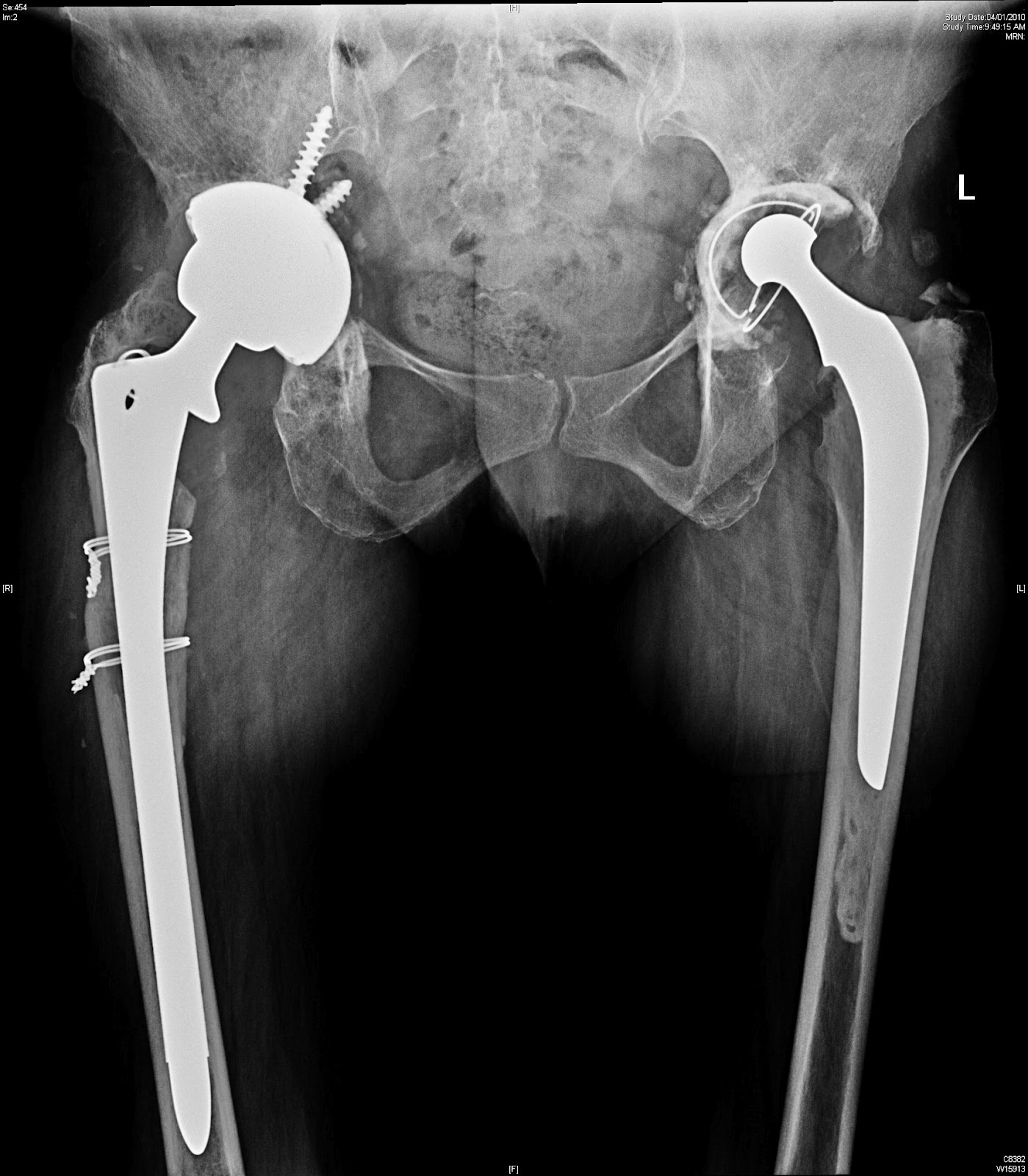
6 years post MOM bearing presented with infected THR(psuedomonas).   The cup became vertical a year ago. Patient continued visiting various hospital and was put ion oral antibiotic. Stage 1  excision arthroplasty with HAP granules soaked in antibiotic(vancomycin) and 6 weeks of IV antiobiotics were administered
Stage 2 revision with trabecular metal augment and trabecular metal cup and wagner  stem with ceramic on poly bearing

Sunday, 6 May 2012

Osteoarthritis knee- post trauma tibia vara

 62 year old lady 5 year post open fracture tibia presently with pain and instabilty. ESR and CRP are normal. An oblique scar(red Line) below the knee healed by primary intention.


 Problems .
Medial tibial condyle has collapsed.
Mcl end point felt.
The oblique open wound distal to the tubercle is healed by primary intention and will not interfere with the  TKR incision unless osteotomy below
Sclerotic irregular eccentric canal

Options and comments please 

 Our templated plan is below including an oblique  lateral  entry to be central distally . The end result is further down. comments please.

Tuesday, 1 May 2012

Supracondylar fracture with RA and secondary OA in 65 year old lady


osteoporotic Patient with RA and supracondylar fracture
 Options
1. Fix and  TKA
2. Fix and TKA later
3. TKA now

Sunday, 29 April 2012

Bilateral hip ankylosis with HO

 Case refered by Dr. Mukesh Ladda from nagpur for opinion.
Please  give your views and comments

54yr male diabetic presented with bilateral stiff hip since one yr,slowly progressive to total stiffness since last six months.
History of septicemia with multiorgan failure one n half yr ago,recovered well but unable to stand or sit due to bilateral stiff hip.

His  question are as follows? My comments below are open to your valuable comments and views
1.Is THR only option?
With the sort of long standing Ankylosis the articular cartilage nutrition suffers and result in fibrous or bony ankyloisis. The question whether this was the result  of septic arthritis or due to neuraxial injury could be partly answered by ESR, CRP and intraop frozen section. Being a diabetic an HBAIC is advised. IF proven to be infected could consider girdlestone with local antibiotic delivery could be a choice before THR. If not A THR with the largest possible head to avoid dislocation

2.What will be the status of Abductors after removing HO?
 I would go dead lateral, split the TFL with anterior and posterior with bone slivers from the G. Troch. Do a neck ostetomy and remove the head, Ream or piece meal. After this the bone anterior and posterior can be removed  slowly exposing the bone subperiosteally and reove all the impinging bone. You want to watch for N/V damage  palpating vessels and preop MRI angio  if needed to asses where the vessels are embedded if needed. The all important homan's retractor, electroquatery  helps exposing the HO. The one similar case i did had a compartmental syndrome of thigh and femoral neurpraxia which recovered partially in 6 months. The contralateral hip was done 6 months later and laser was used toquarterise the bleeding bone to avoid compartmental syndrome. Those days we did not have any local thrombin delivery to stop bleeding if possible.

3.When should i do the second hip(gap between two THR)?
I would wait 3 to 6 months only for recovery
4.What are  the chances of recurrence? In my only experience of a bilateral case the xrays below the hip failed with a psuedo tumor due to MOM articulation with an XL head.

5.Radiothearphy protocol pre & post op?
My choice is radiation the morning before operation( experimental evidence in literature)

Below is a similar case I discussed before, So far I could trace only the preop and one post op at 3 months. will trace the entire series  in a few days once I get back to get the whole story.

Dr. Mojieb's Comments are added below

1- Would pre operative aspiration add value too to ascertain the possibility if this being post sepsis or not
2- Any role for Posterior Approach ???
That might give u a better opportunity of visualizing & protecting the hip abductors.The only issue will be, where to osteotomize the ankylosed  hip which I think u can do it a bit low , just above the lesser trochanter , this will help you retract the whole femur + abductors out of your way than ream away the acetabulum piece meal initially than as the landmark for the ant+ post columns become available u can place the Homan.

I like your idea about the neurovascular structure concern & the use if laser for bone cauterization
I personally have not used laser before but seems to be a great idea.

Sunday, 22 April 2012

Asymmetric polywear in a tkr

I do not have the initial postop xrays taken at the time of index procedure done elsewhere. Hence, not sure whether improper balancing was one of the causes for  early  polywear ( 7 years)


 This was revised with legion revision system. The implants werte well fixed but the poly liner is not available anymore at least in india( FS knee) hence the total revision

Tuesday, 17 April 2012

lessons learned-Sequelae of open fracture talus with medial malleolus fracture


He has  pain on wt bearing with Varus hind foot and gross painful restriction of ankle movement. Varus of ankle can be partially corrected short of neutral.  Subtalar movemnts are terminally restricted but painless. Midfoot and tendons are normal.


1. Is this AVN with collapse.
2. Malunion with Sec OA
3. Investigations if any

4. what are the options
 we did an arthroscopic ankle fusion. the reasons and problems are discussed in the comments


Now after 3 months the ankle is solid fused has lateral pain from an abuting osteophyte or should one call it unionophyte. The disheartening xray is of .> 10 gegree varus which i feel i would  need correction thru a transfibular approach when symptoms arise. He is on a rocker heel slippers to simulate heel toe gait.


1.      He was referred for ankle replacement. We did a bone scan to rule out AVN and decided to do an arthroscopic ankle fusion as he was young and works as a electrician. I believe an ankle replacement at this age may not be a good idea. As his subtalar joints were relatively normal an ankle fusion was chosen. In view of his varus deformity we planned to open if the deformity was not corrected, By clearing the lateral gutter with Shaver and burr we could correct the varus and hence only the medial malleous screws were removed and percutaneous tibiotalar screws were inserted. Unfortunately one of the guide wires broke and intraop screening showed it to be intraosseous. However the postop xray showed the wire protruding into the sinus tarsi. I am hoping for an early fusion and hopefully no subtalar symptoms


Lessons learned.


1. Do not attempt arthroscopic fusion in the presence of varus deformity which is not passively correctable

2.My reason to attempt the same was due to the medial and lateral as well as anterior skin inscisions which would compromise wound healing as well as after taking out the lateral osteophyte i felt i corrcted the deformity refer xrays above which I know now was never a true AP

The Xrays below are refusion at  6 weeks postop. The fusion clinically feels solid. We have delayed wt bearing and left the foot unsupported inspite of bridging anteriorly and posteriorly as open fusions generally take 3 months to fuse.

Over all arthroscopic ankle fusions have above 95% fusion rates at 12 weeks. My personal series of 18 cases have all united execpt for 2 malunions both of which the indications were flawed due preop varus deformity as above which were only partilly corrected.


Sunday, 15 April 2012

Price one pays for delayed revision in aseptic looseningr


This patient, a 44 year old rheumatoid lady underwent revision of rt hip in 2005  with MOM where in  we  advised revision of the lt. cup. Financial reasons or otherwise, she comes  7 years later with the cup migration. comments please. Her metal ions are fine. The xrays are in chronological order. Early revision could have saved much bone and made surgery easier.
1 
Would have loved to revise early without bone loss. Superiomedial migration suugest anterior column deAs the anterior column was compromised we could get good host bone with more than 70% contact with a jumbo trabecular cup and a wagner stem 

Monday, 6 February 2012

modified hardinge approach

Modified hardinge Approach maintaing 2/3rds of the medius  and releasing towards the lesser trochanter and not vertically downwards maintain the medius- lateralis tension band as well as exposes the acetabulum and the femoral shaft necessarsary for standard THR. Why violate tissue when you dont need to?

Wednesday, 1 February 2012

Revision ACL

5 months after ACL reconstruction Rom 15 to 90. why should this happen. What  to do now


On Scopy a "cyclops" lesion was seen. this was shaved of and a wide notch plasty was done to prevent further impingement. Full extension was acheieved however flexion was still limited. The suprapatellar pouch and the medial and lateral gutters were leared of the scar. Patellar mobility and full rom was achieved with medial and lateral patellar release which was the next stage of the plan.

Patellar impingement with femoral condylar plate

28 year old Salesman 8 month post orif of Intercondyalr fracture femur. Presented with ROM 10 to 80 degrees ans pain on extension.
O/E. decreased patellar mobility, Clicking band(Plica) lateral to patella at 20 to 10 degrees of extension. Cruciates and collateral stable.  views please